Stevie Mackenzie-Smith reflects on Quarantine’s Battersea Arts Centre takeover, part of Welcome to Wandsworth – The Mayor’s London Borough of Culture 2025-26.
In a previous life, Battersea Arts Centre (BAC) was the borough’s Town Hall, known for radical politics, including infamous speeches and debates on religion, suffrage, social housing and art.
The Centre’s exterior stone balcony that overlooks the bus stops and bustle of Lavender Hill, was once the site of many a public address when the building was still the Town Hall. It’s been decades since the balcony was used in this way, but on a damp night in early March 2026, it was brought back to life.
Quarantine, Why I am and why I am not: Part 1: The Balcony.

Battersea Arts Centre, 2026. Photos: Ewan Michael Riley

Uplit with magenta lighting, and watched by a crowd huddled beneath umbrellas from the pavement below, the balcony stirred as one by one, 12 people each came to give a speech. The subjects, chosen by the speakers themselves, ranged from the personal to the universal; from the virtues of being loud to fearlessness. To an onlooker the spectacle might have passed as a rally or political gathering.
It was neither, technically, of these things but a performance – Why I am and why I am not – a co-production between BAC and award-winning Manchester theatre collective Quarantine. The prompt for Why I am and why I am not was British philosopher Bertrand Russell’s famously provocative speech ‘Why I am not a Christian…’, given at Battersea Town Hall in 1927, decades before the building became an arts centre in 1974, and 99 years to the day that the speakers took to the balcony. The performance formed part of Quarantine’s four-week takeover of BAC, A Public Address, part of Welcome to Wandsworth – The Mayor’s London Borough of Culture 2025.
Using the building’s former role as Town Hall as inspiration, A Public Address brought people from across Wandsworth together, asking: who gets heard in a place like this today?
For nearly three decades, Quarantine have been making evocative work centred on conversations between ordinary people and creating circumstances for encounters between strangers. The ensemble created the work with a huge range of people across Lavender Hill and the wider borough, sharing a rare insight into people’s lives and how they see the world. As such – and true to Quarantine’s idiosyncratic performance work – A Public Address danced at the edges of theatre and civic art.
Across four strands, through intimate encounters, conversations and grand-scale durational performance, A Public Address was a chance for audiences and performers alike to slip between looked-at and onlooker.
Clovis, part of Quarantine’s The people of Lavender Hill, 2026. Photo: Kate Daley

The takeover spread beyond the building and into neighbouring streets, businesses and places of quotidian gathering: along Lavender Hill, Battersea Park Road, St John’s Hill, at a hairdressers, hardware store, launderette, betting shop, cafés, coffee shop, Church of the Ascension and more.
In No Such Thing (16 Feb – 13 Mar 2026), the lines between performance and encounter were blurred again. The idea was simple – Quarantine bought lunch for an audience of one, in exchange for a conversation guided by a menu of questions. Taking place at four separate venues – including Jimmy Griddle, Viet Caphe and Pique – No Such Thing gradually roamed closer to home at BAC, culminating at Tom’s Café on site. No Such Thing again prompted its singular audience to wonder: is this a performance, or real life?
Workers at Pique, a venue for Quarantine’s No Such Thing, 2026. Photo: Steve Reeves

Quarantine’s work has always quietly and determinedly poked at essential questions: what are we all doing here? How do we spend our days? The ensemble – which is made up of cross-disciplinary artists, producers, writers and performers – has a distinctive talent for creating and emitting that unspoken energy that comes from unexpected and vivid meetings between strangers.
It’s perhaps unsurprising then, that Quarantine have a certain magnetic power that keeps long-time collaborators in their orbit. Along the way, they have acquired a niche yet international reputation for intellectually rigorous, socially progressive and formally inventive work. Those in the know are dedicated and enthused followers, and those encountering the work anew find something instantly compelling. I know this first-hand. I first came across Quarantine fresh out of university and was quickly pulled into their lightning field.
As with most performers on a Quarantine stage, I had no experience of standing beneath stage lights. Yet in 2014 that’s what I did for several nights inside a warehouse in an industrial estate in Salford. I was one of an assortment of non-actor volunteers involved in Summer. Spring. Autumn. Winter., an epic project about the human life cycle and our relationship with change. Typically, the performers in that production were from all seasons of life, including toddlers.
You never know what might unfold in a Quarantine performance – the team itself is often in the dark until the live hot moment. In the years since that first experience, I’ve continually watched with fascination to see what Quarantine will do next.
The day after the speeches on the balcony in March 2026, the 12 speakers returned to BAC for The Rooms, where the public joined them for conversations about what they had declared the night before. Why I am and why I am not in its entirety is a portrait of people and place that examines the relationship between our public and private selves, who we are and who we proclaim to be.
Quarantine, Why I am and why I am not: Part 2: The Rooms.

Battersea Arts Centre, 2026. Photos: Ewan Michael Riley

Back outside the building, The people of Lavender Hill (6–14 March 2026) was an audio walk that brought together stories from BAC’s local community. Designed to be listened to via smartphone on a specific route along Lavender Hill, it was an audio portrait of individuals who all happen to work along the same street. Quarantine’s ongoing occupation with subversion invites a different kind of city walking tour. Instead of heritage locations, walkers are invited to pause – at the corner shop, or the late-night takeaway, to hear from the people behind the counter.
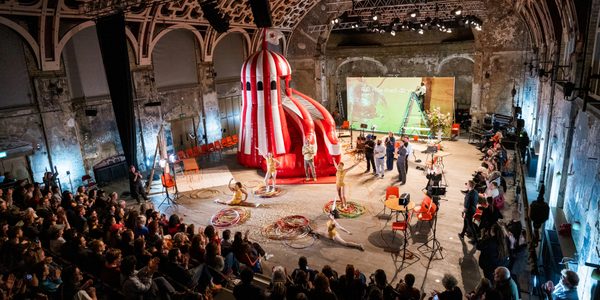
The takeover culminated with a grand, durational 12-hour performance on 14 March 2026. For 12 Last Songs Quarantine invited people from across Wandsworth to work a paid shift on stage in an exploration of the place work has in our lives. It was the ninth such iteration, with previous international productions in Australia, Germany, Ireland, Scotland and England, and this marked the first and last chance to experience 12 Last Songs in London.
Quarantine, 12 Last Songs, at Battersea Arts Centre, 2026. Photo: Ewan Michael Riley

The performance roved between quiet dailiness – a butcher jointing a row of chickens, a painter and decorator wallpapering, and arresting spectacle – a parade of gymnasts, confetti canons, a giant inflatable helter-skelter. With so much wonder and beauty unfolding at once across the stage it felt like the natural culmination of the takeover; though that might not be how Quarantine would see it. Instead, each piece in A Public Address was presented intentionally without hierarchy. A geographical and human ‘zooming in’, that shifted between the public and the private, the epic and the intimate.
Quarantine, 12 Last Songs, at Battersea Arts Centre, 2026. Photo: Ewan Michael Riley

Each work in A Public Address contrasted in scale, but the approach remained the same. Like life itself, every piece brimmed with human connection. Some more quietly than others, but unmistakable nonetheless. Mic-ed up and seated in the audience, one of the workers in 12 Last Songs – a theatre critic scribbling the action live into her notebook – shared what she saw: “The world is full of people getting by, being kind and following their passions. And seeing this, I remember: I love people!”